- NanoBits
- Posts
- What's common between a Japanese toilet company, your AI prompt, and MSG (monosodium glutamate)?
What's common between a Japanese toilet company, your AI prompt, and MSG (monosodium glutamate)?
The science, history, and geopolitics of semiconductors

Monalisa Sethi
March 08, 2026

EDITOR’S NOTE

Dear Nanobit Readers,
Can you folks hazard a guess which company’s stock chart this is?
I will give you two hints:
It’s a Japanese company [you would have guessed from JPY].
My next hint would be that it is not an AI company, not a chip company; in fact, it's not even a tech company.
It’s Toto, a sanitary ware company from Japan; to put it simply, this company makes toilets!
Very recently, researchers and investors at Toto realized that the type of ceramics used in its manufacturing process plays an important role in semiconductor manufacturing. Ceramics are able to withstand very high temperatures, which makes them well-suited for semiconductor production.
As a result, the stock jumped nearly 1.5x over the past six months. I am showing you this because I want you to consider the bigger point: if a toilet company in Japan can see its stock rise 1.5x in six months by recognizing its role in a small but important part of the semiconductor manufacturing ecosystem, just imagine the influence the world’s biggest semiconductor and AI companies have on our everyday lives.
Factually, over 80% of the global economy directly or indirectly depends on semiconductor-enabled systems.
Let me give you a hypothetical. Say tomorrow at 8:30 a.m., one of the world’s biggest semiconductor factories goes offline for the next six months. What do you think would happen to us? Any quick guesses?
Tech would slow down first. No more cars. Prices would increase.
So you get the point, right? A huge share of the economy depends on semiconductors.
It would start with one sector, say automotive, getting hit first. Then defense systems. Then the internet. Then UPI. Then you would not get the next iPhone release or the next MacBook release, and the effects would keep spreading.
If you look around, everything from consumer electronics to computing and AI, to the internet, automotive, and defense systems, all of it directly and tangibly depends on semiconductors as the core foundation of these systems.
In today’s edition of Nanobits, we will walk through the history, science, and geopolitics of semiconductors. Here’s what we will cover:
We will start with the science and unpack the technical foundations at a high level.
Then we will move into the history of chips, look at where it all began, and how the industry evolved over time, along with the geopolitical forces that shaped it.
Finally, we will cover the modern chip war that started in 2020 and trace how it has unfolded into the global story we live through today.
A Special Note for Women's Day
Today is International Women's Day, and it feels like the right moment to flag something worth paying attention to. Women are about 20% less likely than men to use generative AI tools like ChatGPT and Claude. And that gap has real consequences: the less women use these tools, the more AI systems get trained on data skewed toward men, and the wider the divide grows.
This year, we ran two workshops on the roadmap to becoming an AI generalist for the Women of IIM AI Practitioners and Enthusiasts group, and the energy in both rooms made one thing clear: the will is there, the curiosity is there, and the capability is there. What works is a structured, peer-driven way of learning that gets straight to practical application. If you are a woman reading this and want that kind of structure, reply to this email. We are happy to help.
Sand, Switches, and Silicon
Everything around you is made of atoms. Atoms are made of protons, neutrons, and electrons. When electrons move, that movement is electricity. The entire game of semiconductors comes down to one question: can you control how electrons move?
Silicon sits right in the middle of the periodic table's fourth group, with four electrons in its outer shell. Metals have loosely held electrons, so electricity flows through them easily. Non-metals hold electrons tightly, so electricity does not flow at all. Silicon does neither by default. It can be pushed either way, and that is exactly what makes it useful.

Periodic table’s 4th group is highlighted in red
The way you push silicon either way is by mixing in a tiny amount of another element, a process called doping. Think of it like seasoning. Add the right element and you get extra electrons moving freely through the material. Add a different one and you create gaps that carry charge in the opposite direction. Either way, you now have precise control over whether electricity flows or not. Turn it on. Turn it off. That is a switch. In electronics, that switch is called a transistor.
A transistor has three contacts: a source, a drain, and a gate. Electrons travel from source to drain. The gate controls whether they can. No moving parts. Just a small voltage deciding the fate of billions of electrons across a distance invisible to any microscope you have ever seen. Those electrons are what make your phone, your car, and your airplane work! If you want to learn more about how a transistor works, you should watch this video:
Stack enough transistors together and you get a logic gate. A practical example: a car that will not start unless the seatbelt is on and the handbrake is released. Both conditions have to be true. That is an AND gate. Combine millions of logic gates, and you have a chip, a CPU, a GPU, or the processor running the AI model you used this morning.
To print billions of transistors onto silicon, manufacturers shine light through a stencil onto a wafer, a process called photolithography.

This is the image of a photolithography machine.
As transistors got smaller, standard UV light became too coarse to print them accurately. The solution was Extreme Ultraviolet light, EUV, with a wavelength five times shorter than standard UV (You should watch the next video if you want to learn more about how chips are printed). One company makes the machine that generates it: ASML, a Dutch firm. Each machine costs upwards of 400 million euros. Why this matters is the subject of the next two sections.
Before we get there, one thing worth knowing about the numbers you read in chip headlines. When a chip is described as built on a "2nm process node," that is not a precise physical measurement. Until the early 2000s, the node number did correspond to the actual distance between transistor contacts. Now it is a generational label, a way of saying this chip is more advanced than the last one. The 2nm chip is not literally 2 nanometers across. But it is more capable, more power-efficient, and harder to make than the one before it.

From a hotel room in Chicago to a trillion-dollar industry
So now you know what a transistor is. But knowing what something is and knowing how to build a billion of them reliably, cheaply, and at the size of a DNA strand are very different problems. The story of how we got there is, more than anything else, a story of ego, defection, and very good timing.
The year is 1947. World War II ended two years ago. One of the clearest lessons from the war was that the vacuum tubes powering navigation systems and defense equipment were catastrophically unreliable. A vacuum tube is roughly the size of your palm, made of glass, and packed with mechanical parts. The first modern computer, ENIAC, used 17,000 of them. Researchers at Bell Labs were tasked with finding something better.

This is a collection of various vintage electronic vacuum tubes.
Three men worked on the problem. William Shockley had mapped out the physics of the transistor on paper but had not managed to prove it experimentally. On a December afternoon in 1947, his colleagues John Bardeen and Walter Brattain proved the theory worked, and Shockley was not in the room. He locked himself in a Chicago hotel room for two weeks and emerged with the design of the first functional transistor. All three shared the Nobel Prize in Physics in 1956.
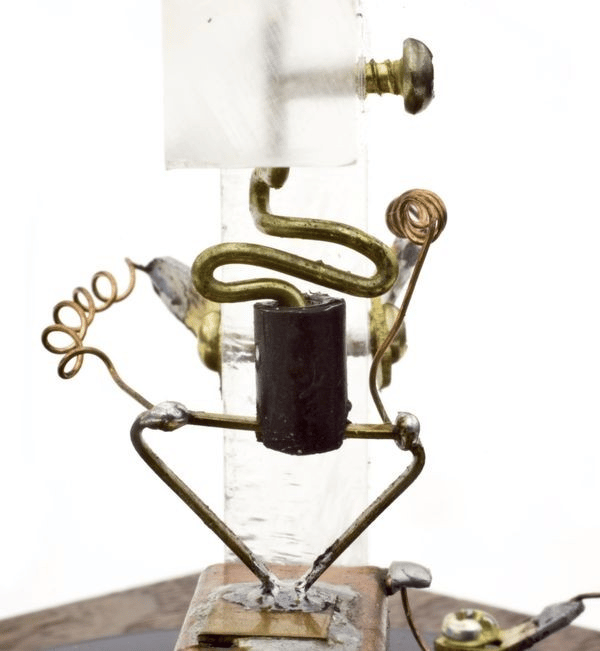
This image shows a replica of the first working transistor, a point-contact transistor invented at Bell Labs in 1947.
Shockley's ego did not shrink with the Nobel. He started Shockley Semiconductor Lab in California, handpicked eight brilliant engineers, and promptly made their lives miserable. All eight left, borrowed money from an East Coast investor named Sherman Fairchild, and started Fairchild Semiconductor. Shockley called them the Traitorous Eight. What they actually started was Silicon Valley. Gordon Moore, one of the eight, noticed that transistor counts on a chip were doubling roughly every two years. That observation became Moore's Law. From Fairchild came Intel, AMD, and National Semiconductor.
Meanwhile, in a TI lab in Dallas in the summer of 1958, a new hire named Jack Kilby had no paid time off yet. His colleagues left for summer break. Kilby stayed and solved the integration problem alone. He took a single block of germanium and doped different regions of it to form multiple transistors on one piece of material, no hand-wiring required. That was the first integrated circuit. Robert Noyce at Fairchild later improved the design using photolithography, making it manufacturable at scale. Kilby received the Nobel Prize in Physics in 2000.

This image shows the world's first working integrated circuit, demonstrated by Jack Kilby at Texas Instruments on September 12, 1958.
The IC proved chips could be mass-produced. But mass demand created a new problem: who would make them consistently enough to supply the world? That question was answered in 1987 by Morris Chang, who founded TSMC with backing from the Taiwanese government. His bet was simple: the factory is the product. Companies should design. TSMC would build. Today, TSMC manufactures over 90% of the world's most advanced chips, all from one island, 180 kilometers off the coast of China.
That last detail is not incidental. It is the entire next section.
The Chip War nobody talks about at dinner
One company, on one island, 180 kilometers off the coast of China. That sentence is the entire premise of modern semiconductor geopolitics. To understand the tension, you need to understand who controls what in this industry and why each piece matters.
Think of the global semiconductor supply chain as a set of chokepoints. Whoever controls a chokepoint controls the flow of chips, and whoever controls the flow of chips has enormous leverage over the rest of the world. There are five players worth understanding.
The US: The Gatekeeper
The United States does not manufacture the most chips. It does something more powerful. It controls the ideas behind them. The biggest chip designers in the world, Nvidia, Qualcomm, Apple, Broadcom, are all American companies. The two firms that make the software engineers use to design chips, Cadence and Synopsys, are American. Key manufacturing equipment suppliers like Applied Materials and KLA are American. And critically, the US supplies intellectual property to ASML that goes into building EUV machines. That last point is the sharpest tool in the box. Because US technology is embedded in ASML's machines, Washington can tell ASML who it is and is not allowed to sell to. If you design a chip, you pass through the US at some point. There is no way around it.
Taiwan: The Factory Floor
TSMC is a $1 trillion company. It manufactures over 90% of the world's most advanced chips. Every iPhone processor, every GPU in every AI data center, and key chips in military systems all come out of fabs on a small island. Taiwan does not compete with its customers. It does not design chips. It builds what others design, and it builds them better than anyone else. That singular focus is its strength and its vulnerability. Taiwan's geopolitical importance is, in large part, a function of TSMC's existence. Without TSMC, the calculus around Taiwan changes significantly.
ASML: The Sole Supplier
One Dutch company makes the only machine capable of printing chips at advanced nodes. Each EUV machine costs upwards of 400 million euros, takes years to assemble, and involves hundreds of supplier components from across the world. No other company on earth makes one. This means every advanced chip, in every device, in every country, depends on a single manufacturer in the Netherlands. The US, by virtue of its IP embedded in the machine, effectively controls who gets access to it. China does not.
China: The Aspirant
China is the world's largest consumer of semiconductors. It has poured over $100 billion in state subsidies into domestic chip firms like SMIC, and its Made in China 2025 policy has pushed hard for self-reliance across the supply chain. But it cannot get EUV machines. Without EUV, it cannot manufacture at advanced nodes. Without advanced nodes, it cannot build the chips that power modern AI, defense systems, or high-end smartphones. China is working around this through parallel supply routes, domestic workarounds, and significant investment in older manufacturing processes. It controls demand but not the chokepoints. It also controls something else: rare earth minerals. These are materials used in magnets and electromechanical components across the supply chain, particularly in automotive and defense. China dominates rare earth mining globally, partly through its Belt and Road investments in countries like Afghanistan and Sri Lanka. That is its own form of leverage.
China also wants Taiwan. Part of why it wants Taiwan is TSMC.
India: The Emerging Player
India's role in this story has two sides. On the design side, India already punches well above its weight. Over 25% of global chip design engineering happens here, concentrated largely in Marathahalli, Bangalore. Qualcomm, Nvidia, Broadcom, and TI all have large design teams in India. IIT Madras has developed the Shakti processor, India's first domestically designed chip architecture.
On the manufacturing side, India is earlier in the journey. The India Semiconductor Mission launched in 2021 with a $10 billion incentive to build local manufacturing capacity. The first wafer fab has been approved in Gujarat, a joint venture between Tata and PSMC from Taiwan. A packaging and test facility, a joint venture between Micron and Tata in Sanand, Gujarat, was inaugurated recently. These are early steps, but they are real ones, and they fit into a broader global push to diversify manufacturing away from Taiwan.
Where does this leave us?
The semiconductor supply chain is one of the most concentrated in the world. A handful of companies, in a handful of countries, control the tools, the knowledge, and the factories that everything else depends on. A toilet company in Japan sees its stock rise 1.5x because its ceramics matter to one small part of this process. MSG, the food additive, is a meaningful input to chip packaging. The supply chain reaches into places nobody expects.
What started in a Bell Labs lab in 1947 as a solution to an unreliable glass tube is now the backbone of the global economy and the most contested industrial terrain on the planet. The next time you read about US export controls, Taiwan tensions, or China's chip ambitions, you will know exactly what is at stake. It is not just technology. It is the switch that everything else runs on.
If you want to go deeper, Chris Miller's Chip War is the single best place to start. It reads like a thriller and covers the full arc from the transistor's invention to the modern chip war. If you want to read something simpler, I would suggest “When The Chips Are Down” by Pranay Kotasthane and Abhiram Manchi.
As a consumer, the choices you make about technology are not neutral. When you generate an AI image, run a prompt, or stream a video, you are drawing on GPU clusters that consume thousands of amperes of electricity and require enormous volumes of clean water for cooling. That energy increasingly comes from nuclear plants being built specifically to power data centers. The physical cost of AI is real and growing.
Two practical signals worth paying attention to when buying devices. Chips built on ARM architecture are more power-efficient than their x86 predecessors, which means less energy consumed over the life of a device. GaN chargers, now common from brands like Apple and Belkin, are significantly more efficient than traditional silicon chargers. Neither choice is dramatic, but across billions of devices, it compounds.
The next iPhone, the next AI model, the next car you buy: all of it runs on a switch smaller than a strand of DNA, made by a supply chain the whole world depends on and very few people think about.
If you liked our newsletter, share this link with your friends and request them to subscribe too.
Check out our website to get the latest updates in AI
Reply