- NanoBits
- Posts
- India Has the Talent, the Trust, and the Infrastructure. Now What?
India Has the Talent, the Trust, and the Infrastructure. Now What?
What 181 sessions on Education, Skilling & Society actually revealed about who India's AI future includes

Geetika Mehta
March 01, 2026

EDITOR’S NOTE
Dear Nanobits readers,
Last week we covered IndiaAI Summit’s AI Governance & Policy track, the track that told us India is no longer a rule-taker in global AI standards. This week we go into the two tracks that had the maximum topics discussed under those themese: ‘Education & Skilling’ and ‘Society & Social Good’.
A quick reminder on where these came from. We built an AI workflow to parse all 529 sessions from the IndiaAI Impact Summit 2026 using Claude Cowork to categorize and analyze the full dataset, and NotebookLM to synthesize content across batches of sessions. Education & Skilling ran 57 sessions. Society & Social Good was the single largest track at the summit with 124 sessions. Together they accounted for 181 sessions and over 283,000 views in four days (the numbers have increased ever since).
I'll be honest about what surprised me. I went in expecting both tracks to feel like the "soft" side of the summit: inspiring examples, feel-good inclusion stories, the usual. What I found was much sharper than that. The sessions on cognitive colonialism, the AI memory wall, the purple economy, and the end of the IT pyramid are not soft topics. They just tend to get less coverage because they're harder to fit into a policy headline.

Let's jump right into the details.
FIRST, THE NUMBERS (AND WHAT THEY HIDE)
The full summit generated 875,673 views across 529 sessions in four days. Education & Skilling drew 128,814 views and Society & Social Good drew 154,750. That's about a third of all summit views, from more than a third of all sessions.
The most-watched session in Education & Skilling was "AI and the Future of Skilling" at 45,000 views. That's more than four times the next session in the same track. The most-watched in Society & Social Good was "AI Is Your New Teammate: How to Work Smarter, Build Faster, and Think Bigger" at 30,000. Look at those titles carefully: neither is about frameworks or policy architecture. Both are about individual agency. That's the audience signal again, same as in Part 1.
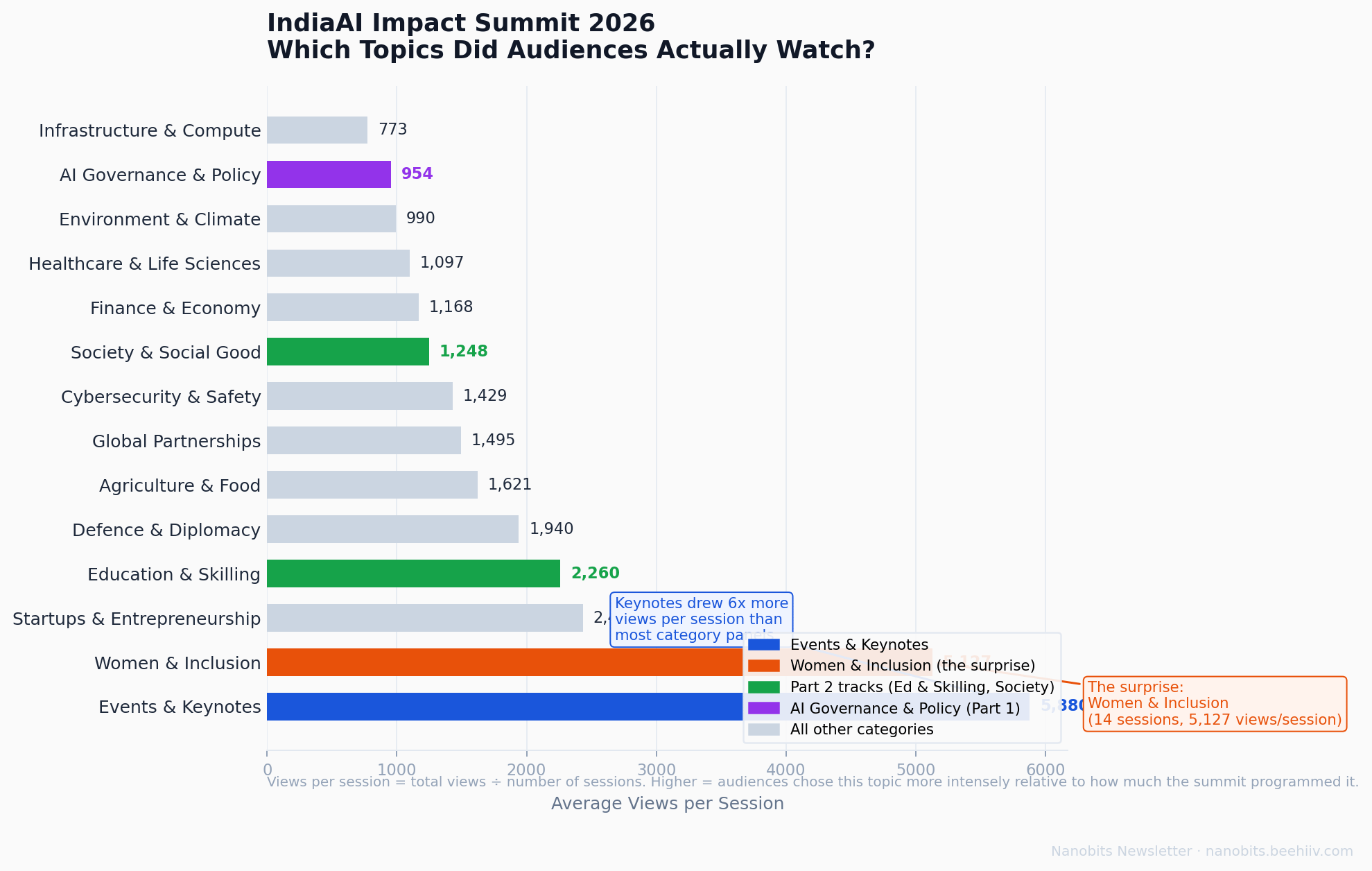
There's a view-count story worth pausing on. Women & Inclusion was a small track: just 14 sessions but drew 71,783 views. That's nearly as much as AI Governance & Policy drew across 92 sessions. If session count reflects what summits choose to programme, view count reflects what audiences actually want to hear. The gap between the two is real and consistent.
Some sessions that probably deserved more eyeballs: the sessions on frugal AI, the AI memory wall, and the purple economy (the $150 billion assistive tech market) each drew a few hundred views. These were among the most technically substantive and practically original ideas at the summit. They got buried in the noise of a 529 session event. That's the same dynamic we flagged in Part 1 with the Nepal Engagement Session at 32 views.
EDUCATION & SKILLING: 57 SESSIONS, ONE UNCOMFORTABLE QUESTION
The uncomfortable question running through all 57 sessions was this: India ranks 1st globally in GenAI course enrollment on Coursera. It ranks 89th in actual skill proficiency. That gap between knowing about AI and being able to use it is the whole problem. And it's a gap no certification is going to close.
The track was not just about classrooms and curricula. A significant portion of it was about the structure of the Indian economy and what happens to 370 million young people when the jobs they were trained for no longer exist. That's not a future risk. For entry-level IT work, it's already happening.
1. THE PYRAMID IS COLLAPSING AND THE REPLACEMENT DOESN'T EXIST YET
The traditional IT services model that built modern India runs on a pyramid. Massive entry-level hiring from engineering colleges. Standardised skilling. Labor arbitrage at scale. That model is now being dismantled from below.
Investor Vinod Khosla said it plainly across sessions: traditional IT services and BPO will effectively cease to exist by 2030. AI can already write 50 to 60 percent of basic code, which means the demand for junior engineers is collapsing. The pyramid is being replaced by what panelists called a "diamond", thin at the bottom, value concentrated in the middle with people who can orchestrate AI agents and apply domain knowledge, thin again at the top.
The flip side is equally disruptive. By 2026, the prediction is we may see the first one-person billion-dollar company. A single individual acting as a "systems architect," directing multiple AI agents, doing what once required an entire corporation. The cost of engineering is "rushing towards zero." What accrues value instead is the ability to understand and frame problems in the first place, not to execute them.
What this means for India's 370 million young people is the real unresolved question. The sessions flagged it honestly. They didn't pretend to have an answer.
2. COGNITIVE COLONIALISM AND THE FIGHT FOR INDIC INTELLIGENCE
The most philosophically charged argument at the summit wasn't about regulation or compute. It was about whose values get encoded into the AI systems that will teach India's children.
Researchers presented findings that current LLMs are trained on Western-centric data that misses fundamental cultural markers. One specific finding: "shame" appears 4.5 times more frequently in Bollywood subtitles than in Hollywood. That reflects a collectivist social structure, shame as community enforcement, that Western models, built on ‘pride-focused’, individualist data, simply don't model. A model trained to "align" to Western norms is structurally misaligned for much of India by design, not by accident.
The response being built is a parallel sovereign infrastructure. Bhashini is working to create small language models trained on India's 22 official languages and 19,000+ dialects. Gyan Bharatam is using AI to decode and "rejuvenate" ancient manuscripts, civilizational knowledge that risks being excluded from the global AI canon entirely if it doesn't get digitized. The Indian Army's sovereign military LLMs, which we covered in Part 1, are the defence application of the same principle. No borrowed brains.
The fear is that the alternative continuing to rely on models trained elsewhere, reflecting values calibrated elsewhere is a form of cognitive colonialism. The word was used by multiple panelists across multiple sessions. It wasn't hyperbole. It was the frame.
3. THE BAZAAR MODEL AND THE 96% MATH OUTCOME IN RAJASTHAN
The most optimistic framing at the summit and the one that felt most distinctly Indian came from MIT and UN experts who described the world moving from a "factory model" of AI to a "bazaar model."
The factory model: four or five giant companies build centralized models that everyone else accesses as a service. Intelligence flows down from the center. The bazaar model: every individual runs a personal, sovereign AI agent, an "always on" autonomic cognitive assistant that learns specifically from and for them. A math teacher in Rajasthan doesn't share the world's AI tutor. She has her own.
The evidence this isn't just theory: an AI-personalized learning programme in Rajasthan schools reportedly raised mathematics outcomes to 96% in just six weeks. That number is striking enough to warrant skepticism, and to warrant investigation.
India's Digital Public Infrastructure: UPI, Aadhaar, Bhashini, is the open rail on which this diffusion model can actually work at population scale, in a way no other country is currently positioned to replicate. And India's trust dividend matters here: digital infrastructure trust sits at 70% in India versus 25 to 30% in the United States. That's not a footnote. That's a structural asset.
A FEW THINGS FROM EDUCATION THAT DESERVE MORE ATTENTION
The Solo Paradox. Despite massive IT investment over decades, productivity gains have often been near zero because digital tools just overlaid old manual processes. Experts suggested AI can finally break this but only if organisations shift from individual productivity (a faster email) to collective productivity (AI agents running entire workflows autonomously). The potential productivity gain is estimated at around 4%. That's only unlocked when humans stop being the bottleneck and start being the architects.
Adalat AI and the "painkiller" sequencing lesson. This startup focused on automating courtroom stenography judges in India were writing depositions by hand, causing physical pain and creating massive backlogs. By solving the literal pain point first, they earned judiciary trust. Then they introduced "multivitamin" improvements like paperless filing. The lesson for any AI implementation trying to enter a slow-moving institution: lead with the painkiller.
India as second-order beneficiary. A compelling strategic argument: just as Walmart profited more from cars than Ford did, India may capture more value by building an application layer on top of foundational models built elsewhere than by competing in the high-capex race to build the foundational models themselves. The 95% of global GDP outside the IT sector — manufacturing, agriculture, informal economy — is the real prize.
SOCIETY & SOCIAL GOOD: THE LARGEST TRACK, THE HARDEST QUESTIONS
124 sessions is a lot to synthesize. What held them together was a question that sounds simple and isn't: who actually gets left out?
If Governance asked "what rules do we need" and Education asked "what skills do we need," Society & Social Good asked something harder. Not just who benefits from AI, but who gets excluded by it, invisibly, because the data that trained it didn't include them, or the connectivity required to use it doesn't reach them, or the language it speaks isn't theirs.
The track ranged from highly technical, biosecurity, the AI memory wall, post-quantum cryptography to very practical, road safety, maternal healthcare, courtroom efficiency. The binding thread was that AI is not neutral. How it diffuses determines whether India's growth story includes 1.4 billion people or concentrates its benefits among those already connected.
4. COMPUTE SOVEREIGNTY AND THE BIOSECURITY BLIND SPOT
The most geopolitically urgent insight across both tracks of the summit and it appeared in the Society sessions with particular clarity is about compute. GPU access has moved from being a supply chain question to a sovereign strategic asset. The numbers: 90% of advanced chips are manufactured in a single location (Taiwan). India ranks first in the world in AI skill penetration and has limited domestic compute infrastructure. That gap between talent and hardware is a strategic vulnerability in a way that matters for every social application being built.
A country that leads the world in AI skills but imports the compute that runs AI is, to use the summit's framing, one geopolitical event away from having its intelligence infrastructure turned off overnight. That's not an abstract risk. API limits, sanctions, and quiet policy changes have already been used as leverage in other technology domains.
The biosecurity dimension got less attention than it deserved, which is its own form of concern. Over 1,500 AI bio-design tools now exist. They have decoupled biological risk from physical containment. Traditional biosecurity relied on inspecting physical labs and tracking material transfers. That model is now outdated. Pathogen modeling and DNA sequence optimization can happen entirely in the digital domain, upstream of any physical lab. The governance infrastructure for this doesn't exist yet. The sessions acknowledged it. They didn't solve it
5. DPI AS THE WORLD'S AI DISTRIBUTION RAIL AND ITS PARADOXES
India's Digital Public Infrastructure is increasingly being positioned not just as a domestic asset but as a blueprint the rest of the Global South can adopt. The DPI-to-AI model uses open, decentralized networks like the Beckn protocol to let individual farmers and local artisans compete on the value they create rather than the platform they use. The Agri-Connect programme in Uttar Pradesh is already being replicated in Ethiopia and Brazil.
The "Blue Dot" revolution makes the most practical version of this tangible. AI makes local jobs, welfare schemes, and services digitally discoverable as location-based points on a map. "Purple dots" for people with disabilities. "Orange dots" for other marginalized cohorts. The idea is that a smallholder farmer in UP can find the scheme she's entitled to through a voice query in her dialect, the same way someone in Mumbai finds a restaurant. That's a deceptively large shift.
But DPI comes with a genuine paradox that the sessions engaged honestly. Aadhaar-powered AI can detect deepfakes and fake biometrics at population scale which is exactly what you'd want for a national identity platform. The same AI capabilities enable industrialized deception through those same tools. The response being built involves Post-Quantum Cryptography to future-proof biometric data against quantum computers, and privacy-enhancing technologies that can verify identity without ever sharing the raw biometric data. This is quiet infrastructure work that rarely makes headlines. It's arguably the most important thing being built.
6. THE PURPLE ECONOMY, PHYSICAL AI, AND THE ROAD SAFETY CRISIS
Some of the most interesting ideas at the summit were the least watched. The "purple economy", assistive technology for persons with disabilities, represents a potential $150 billion market in India alone. The panelists making this argument weren't appealing to charity. They were making a business case: designing for accessibility forces universal design, which makes products better for all users. The fact that this is a $150 billion market that the tech industry has largely ignored says something about whose needs get priced into roadmaps.
"Physical AI", where intelligence moves from screens into the physical world through autonomous vehicles, robots, and smart factories was flagged as the next major wave. India's argument for why it's positioned to lead is interesting: its IT and CS talent pool can treat physical manufacturing as a software-defined problem. Using simulation and digital twins, developers can train robots in virtual environments at near-zero cost before real-world deployment, bypassing the capital-heavy barriers that have historically limited smaller enterprises.
India's road safety numbers are a specific place where this plays out. India has 1.5 to 2% of the world's vehicles and contributes 11 to 12% of global road fatalities. Traditional road signs are subjective and routinely ignored. The proposed solution isn't more signs. It's connected vehicle ecosystems and intelligent infrastructure that automatically reduces a car's speed, or clears a corridor for emergency responders, or routes traffic in real time. India's scale and its severity of the problem make it a natural testbed for this technology in a way that the Netherlands or Singapore is not.
A FEW THINGS FROM SOCIETY THAT DESERVE MORE ATTENTION
The AI memory wall. While the industry obsesses over model size, the actual technical bottleneck is emerging elsewhere. Hardware growth cannot keep pace with the exponential demand for memory and compute. Researchers at the summit suggested the next race in AI is not parameters but context window, the working memory that enables complex reasoning over long conversations. Breakthroughs in mathematical optimization are enabling these tasks to run on CPUs or edge devices like a Raspberry Pi at a fraction of GPU cost. This matters enormously for the frugal AI deployments India is betting on.
Knowledge displacement vs. job displacement. Job displacement gets most of the attention in AI and work discussions. The summit surfaced a subtler risk: knowledge displacement. AI models trained on codified digital data exclude centuries of oral traditions and community-specific practices that have never been digitized. In a country with over 100 languages and dialects, the "compute brain" risks erasing cultural nuances of communities with small digital footprints. Bhashini's language digitization work is the most visible response to this.
The Europe-India third axis. While the US and China dominate five major AI leadership metrics, a proposal emerged for a coalition representing two billion people: Europe's foundational research and capital combined with India's STEM talent and global distribution networks. The goal is strategic autonomy preventing the world from operating inside value systems set by only two countries. This is the first time I have seen it articulated as explicitly as it was at this summit.
Jobless growth as the real policy test. India's GDP is growing. Employment is not growing at the same rate. AI companies like OpenAI have slowed entry-level hiring due to AI efficiency while simultaneously reporting that overall job growth within their enterprises is increasing, because employees are becoming more productive. That tension doesn't resolve cleanly. It's the policy test that will define the next decade.
END NOTE
Across both editions, a few things have come through consistently enough to trust.
India is not one story. It is a country simultaneously first in AI skill penetration and dependent on a single geography for the chips that run AI. It is building sovereign military LLMs and still working out how to give 1.4 billion citizens the connectivity to use them. The summit held that tension honestly, more so than most AI events anywhere.
The frameworks that resonated weren't about restriction. They were about architecture. DPI as the open rail for AI diffusion. Frugal AI as a design philosophy, not a compromise. Sovereignty defined not as isolation but as the absence of someone else's kill switch. The bazaar over the factory. The second-order beneficiary as a legitimate strategic position not a consolation prize.
What the summit couldn't answer and didn't pretend to: is sequencing. India has the infrastructure layer, the talent, the trust, and the political will. What it's still working out is the order of operations when the problems are this large and the window for getting it right is this short.
We built this workflow to catch what a human couldn't watch. Across two editions, 529 sessions, and 875,000 views, I think we got the shape of it right. The texture lives in the sessions that got 83 views. Those are worth watching too.
And if you are interested in learning what workflow we build, check out the workflow below
Until next time!
If you liked our newsletter, share this link with your friends and request them to subscribe too.
Reply